

Nikos Katris: The Sculptor Shaping Santorini’s Volcanic Soul
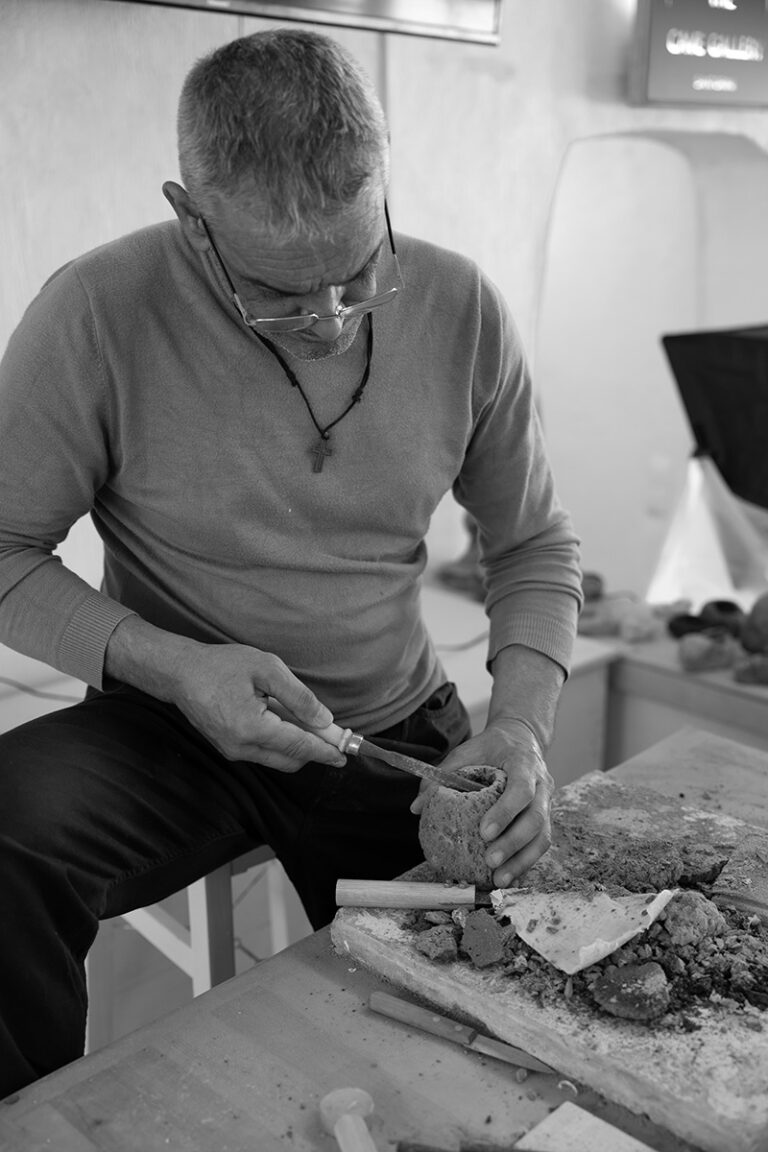
Nikos Katris stands as one of the most emblematic artistic figures in contemporary Santorini, having successfully intertwined his name with the geological history of his homeland. Based in the unique Cave Art Gallery in Akrotiri. Α traditional subterranean space that serves as both an exhibition area and a working studio.
Katris gives form to materials that others might perceive as lifeless. His specialization in sculpting pumice stone and volcanic rock is no coincidence, it is a conscious choice to return to the island’s elemental roots.
Katris’s art transcends is a profound study of transformation. By utilizing the direct byproduct of the eruptions that shaped Santorini, the sculptor attempts to capture the “soul” of the volcanic landscape.
For him, every piece of stone carries a memory spanning thousands of years, an energy released through his chisel. His themes draw inspiration from birth through chaos and Greek mythology and , creating works that seem to emerge directly from the bowels of the earth.
Katris always succeed the anecdote, narrative personal promotion from the particular to the general, the archetype, the metaphysical.
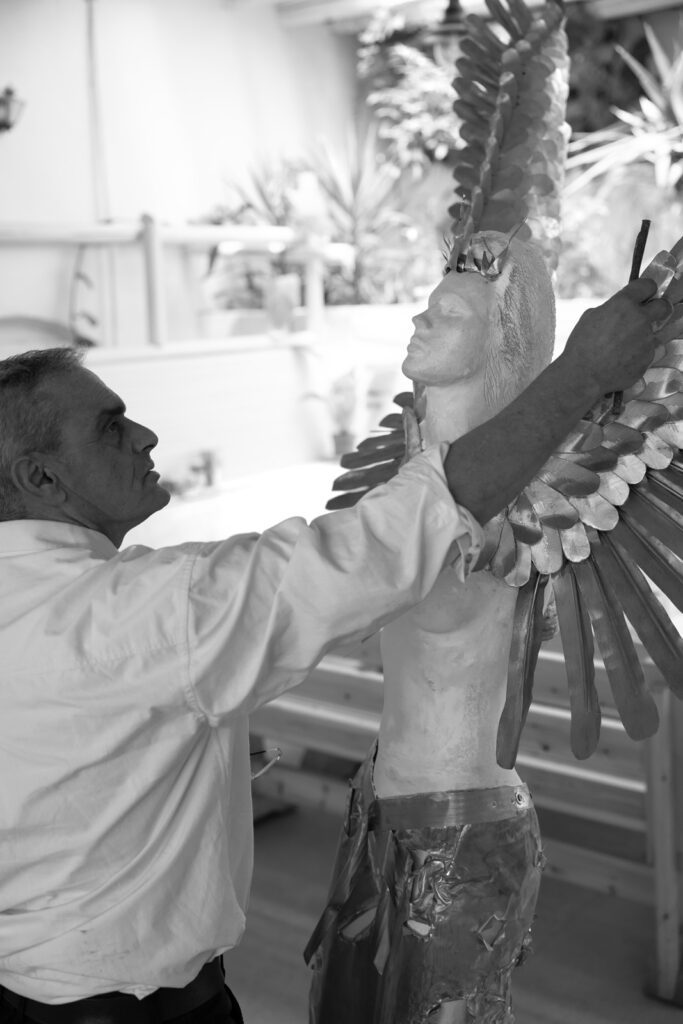
The artistic journey of Nikos Katris is a family affair, adding an extra layer of authenticity to his craft. Collaborating closely with his children, he strengthens the local cultural identity. Furthermore, through his renowned “Sip and Sculpt” workshops, he opens his studio doors to visitors from across the globe. Here, the visitor is not just a passive observer but a participant in the mystery of creation, carving volcanic stone while tasting exquisite local wines.
Katris’s goal for the coming years is the establishment of a holistic experience. He wants every visitor who enters his gallery to leave feeling slightly different, having touc hed something profoundly real. His name has become synonymous with the moment man meets nature and history through art, making The Cave Art Gallery an essential destination for every culture enthusiast visiting Santorini. Through his hands, the silent volcanic rock of the Cyclades finally finds its voice.
Interview: The Soul of the Gallery
- If your gallery were the entire world and these three works were its only inhabitants, what story would they tell about the human experience?
They would tell the story of humanity from its origin to its continuity. The Lady of the Lighthouse (Kira tou Fanariou) speaks of the mother, the root, and the strength that keeps us standing. Kalliste speaks of the destruction that gives birth to something new—of rebirth emerging from chaos. And Eve speaks of the dawn of consciousness, of choice, and of human responsibility toward oneself. Together, they narrate the cycle of life: love, loss, transcendence, and creation.
- When visitors enter the gallery, do you want them to feel awe, serenity, or a sense of provocation? How do you imagine the energy “Eve” will project to someone who first sees her only through a phone screen?
I don’t want them to feel something specific; I want them to feel something authentic. Perhaps awe at first, perhaps silence, or perhaps an inner turbulence. Even through a screen, Eve does not seek to impress. She seeks to look back at you. To make you pause for a moment and wonder who you are and where you began.
- If we were to set aside the aesthetic value of the works, what is the artistic “conflict” and the deeper meaning represented by each of the three pieces?
The conflict is not with the world—it is with ourselves. The Lady of the Lighthouse grapples with the pain of loss and transforms it into light. Kalliste grapples with destruction and gives birth to hope. Eve grapples with innocence and choice. All three works speak of the moment a human being breaks—and then rebuilds.
- What do you believe the public will seek in “Eve” that they cannot find in an ordinary commercial gallery?
They will look for truth. Not something to decorate a space, but something that touches their inner world. Eve is not just a beautiful sculpture—she is a mirror. And whoever stands before her sees a reflection of themselves.
- Five years from now, do you want your name to be synonymous with a specific technique, a specific idea, or the experience of the gallery itself?
I would like my name to be connected with the experience. With that moment when a person enters the space and leaves feeling slightly different. Technique evolves and ideas change, but the emotion that art leaves behind—that is what remains.